
Real estate marketing / Strategy guide
Why Real Estate Video Marketing Fails and How Content Optimization Fixes It
A beautiful listing film can still leave your inbox empty. Give every video a clear job, a useful destination, and the context buyers need to take the next step.
Why does real estate video marketing fail?
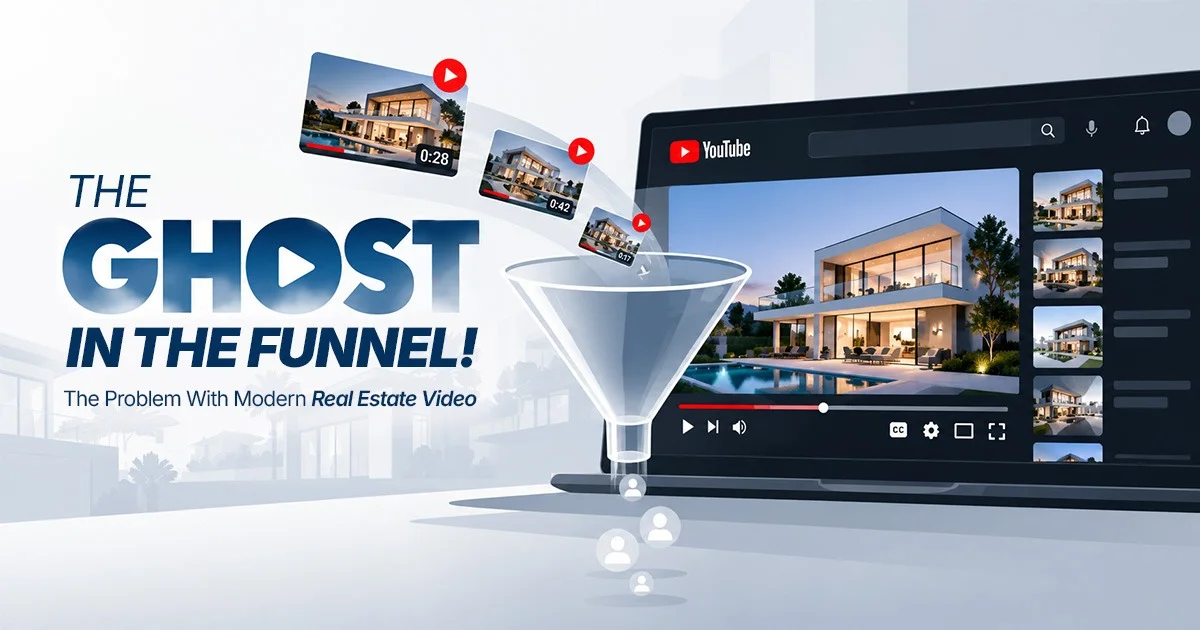
Real estate video marketing can fail when production quality is disconnected from buyer intent. A slow opening, a format that does not suit its platform, missing property context, or an unclear next step can all lose potential inquiries. Content optimization connects the edit, distribution, searchable information, and call to action.
The problem is the funnel, not just the footage
The real estate video playbook used to feel straightforward: capture a cinematic walkthrough, add music, publish the finished film, and share the link. That still creates a useful asset. But a finished asset is only one part of a marketing system.
A buyer scrolling a vertical feed has different needs from someone actively comparing homes in a specific neighborhood. The first needs a reason to pause. The second needs details that help them decide whether a property deserves a viewing.
When one edit is expected to serve both people, it can satisfy neither. A lingering drone shot may establish the setting beautifully, but it can delay the feature that would make a mobile viewer care. A rapid montage may win attention while leaving a serious buyer unable to understand the floor plan.
Recommendation systems use multiple signals; no single hook or retention number guarantees distribution. The practical lesson is simpler: expensive cameras cannot compensate for an opening that gives the intended viewer no reason to keep watching.
Build a two-lane luxury real estate video strategy
Plan one shoot around two different viewing situations. Treat the following lengths as starting points to test, rather than platform rules.
| Decision | Discovery lane | Intent lane |
|---|---|---|
| Purpose | Introduce a distinctive feature and earn attention. | Help a buyer evaluate the property. |
| Starting format | 15–45 second vertical Reel or Short. | 4–8 minute horizontal YouTube tour. |
| Opening | Lead with the strongest relevant feature. | State the location, property type, and reason to watch. |
| Next step | Watch the full tour or explore property details. | Ask a specific question or request a viewing. |
The discovery lane: earn the next click
A concealed room, a terrace with a distinctive view, or a kitchen designed for entertaining can provide a clear opening idea. Show the feature immediately and explain why it matters. Build captions and framing for a phone screen, and give the viewer a direct path to the fuller story.
Simply cropping a landscape film into a vertical frame is rarely enough. Reconsider the opening, subject placement, on-screen text, pacing, and ending for each cut.
The intent lane: answer the buyer's questions
A longer tour should make the property understandable. Show how rooms connect, where daylight enters, how indoor and outdoor spaces relate, and which details distinguish the home. Keep the route coherent rather than jumping between attractive but unrelated shots.
Use a clear introduction, useful chapters, and a relevant call to action. A viewer should finish with a better understanding of the property and an obvious way to contact the agent.
What real estate content optimization actually includes
Real estate content optimization brings the promise of the title, the substance of the video, and the next step into agreement. It starts before export and continues after publication.
- A specific title: identify the location and genuine differentiator. “Modern four-bedroom home with a detached guest suite in [Neighborhood]” tells a buyer more than “Dream home you must see.” Replace placeholders with verified facts.
- An honest thumbnail: feature a real aspect of the property that the video delivers on. Make text legible at a small size.
- A purposeful opening: show or explain the value early, without a long logo sequence.
- Accurate captions: correct place names, measurements, and property terminology rather than relying on unchecked automatic captions.
- A useful destination: send interested viewers to an up-to-date page with the tour, key facts, and a working contact route.
- One clear action: align the ask with intent, from watching the full tour to requesting a viewing.
Our real estate video editing and channel optimization services bring these pieces into a coordinated publishing workflow.
From real estate SEO to Answer Engine Optimization (AEO)
Answer Engine Optimization (AEO) is a way of describing content work that helps answer-oriented search experiences understand and surface useful information. For a real estate business, that means clearly answering the actual questions a buyer asks, supported by accurate, accessible content.
It builds on real estate SEO. Google explains that its AI search features use the same underlying SEO foundations, with no special AI file or schema required. Inclusion is not guaranteed. See Google's guidance on AI features and websites.
Make the important information available as text
Do not rely on a video alone to communicate essential property facts. Publish a readable summary, accurate captions or transcript, and relevant details on the page. Buyers should be able to scan the content as well as watch it.
Verify every factual claim with the listing agent or an appropriate source. A transcript does not establish that a measurement, school assignment, permitted use, or availability claim is correct. Keep changing listing details current.
Write chapters around useful questions
Chapter labels such as “Kitchen and pantry” or “Primary suite and terrace” are more informative than “Interior” and “More rooms.” A chapter such as “01:15 Kitchen with a walk-in pantry” should point to that exact content at that exact moment. Use timestamps from the finished video.
Use structured data where it describes the page
On a page that contains a real, watchable video, VideoObject markup can describe the video's name, thumbnail, upload date, and playback location. The data must match the visible content. Property prices and addresses should not be forced into unrelated video fields.
Only describe videos that are actually available on the page, and keep their metadata current when a tour changes. Consult Google's VideoObject documentation before implementation.
Measure the path to a qualified inquiry
Views are useful context, but they do not tell you whether a video is attracting suitable buyers. Review performance in stages:
- Attention: inspect opening retention and where viewers leave. Compare videos with similar formats and audiences.
- Interest: track clicks from short clips to the full tour or property page using tagged links where supported.
- Intent: track contact requests, property questions, and viewing requests. Check that forms and links work on mobile.
- Qualification: review whether inquiries match the property and whether they progress to a conversation or viewing.
Set a baseline before changing your approach. Test an opening, title, thumbnail, or call to action deliberately, and consider price, location, seasonality, and distribution when interpreting results. Video optimization cannot by itself guarantee a sale.
Turn the strategy into a repeatable workflow
An agent should not need to become a full-time editor and metadata specialist. A clear handoff makes quality more repeatable:
- Brief: confirm the audience, verified property facts, strongest features, and intended next step.
- Capture: plan for both vertical discovery cuts and a coherent horizontal tour.
- Edit: build each format around its own opening and viewer needs.
- Package: prepare thumbnails, descriptions, captions, chapters, and the supporting page.
- Review: check factual accuracy, image rights, links, mobile presentation, and contact routing before publishing.
- Learn: use retention and inquiry quality to improve the next release.
This is the engine behind the output: a luxury real estate video strategy that connects creative decisions to a useful buyer journey.
Common questions
Why do luxury property videos get views but no leads?
The audience may be watching for inspiration rather than actively buying, or the video may lack enough context and a clear next step. Review targeting, the destination page, and contact conversion alongside view counts.
Should I create short videos or full property tours?
Use both when the property and available footage support them. Short clips introduce a reason to care; a full tour helps interested viewers understand the home. Connect the two with an accessible link or platform-supported next step.
Does AEO replace real estate SEO?
No. Crawlable pages, helpful text, accurate information, and clear internal links remain foundational. Answer-focused writing can improve clarity for readers and search systems, but it does not guarantee an AI citation.
Do I need special AI files to appear in Google AI search?
No. Google's published guidance does not require special AI text files or special schema. Focus on accessible, useful content and structured data that accurately describes the page.
Put your content to work
Find where your videos lose buyer attention.
Talk to AK Media House about your channel, video edits, and publishing workflow. Bring your current content and goals so we can discuss the right next step.
Discuss your content strategy ↗